The Focus Year: a goal planner for neurodivergent creatives who keep forgetting their goals exist
If you’re here, you probably have a brain that gets wildly excited about a project… and then forgets it exists.
Same.
Every January I’ve tried to “fix” myself with new planners, new apps, new systems, and a level of optimism that suggests I’ve never met me before. The problem is that most organisational tools assume you’ll do two things consistently:
remember they exist
use them every day
Which is… bold.
So I made something different: The Focus Year: a simple goal planner designed for brains that are creative, distractible, and allergic to rigid schedules.
And yes, it’s free.
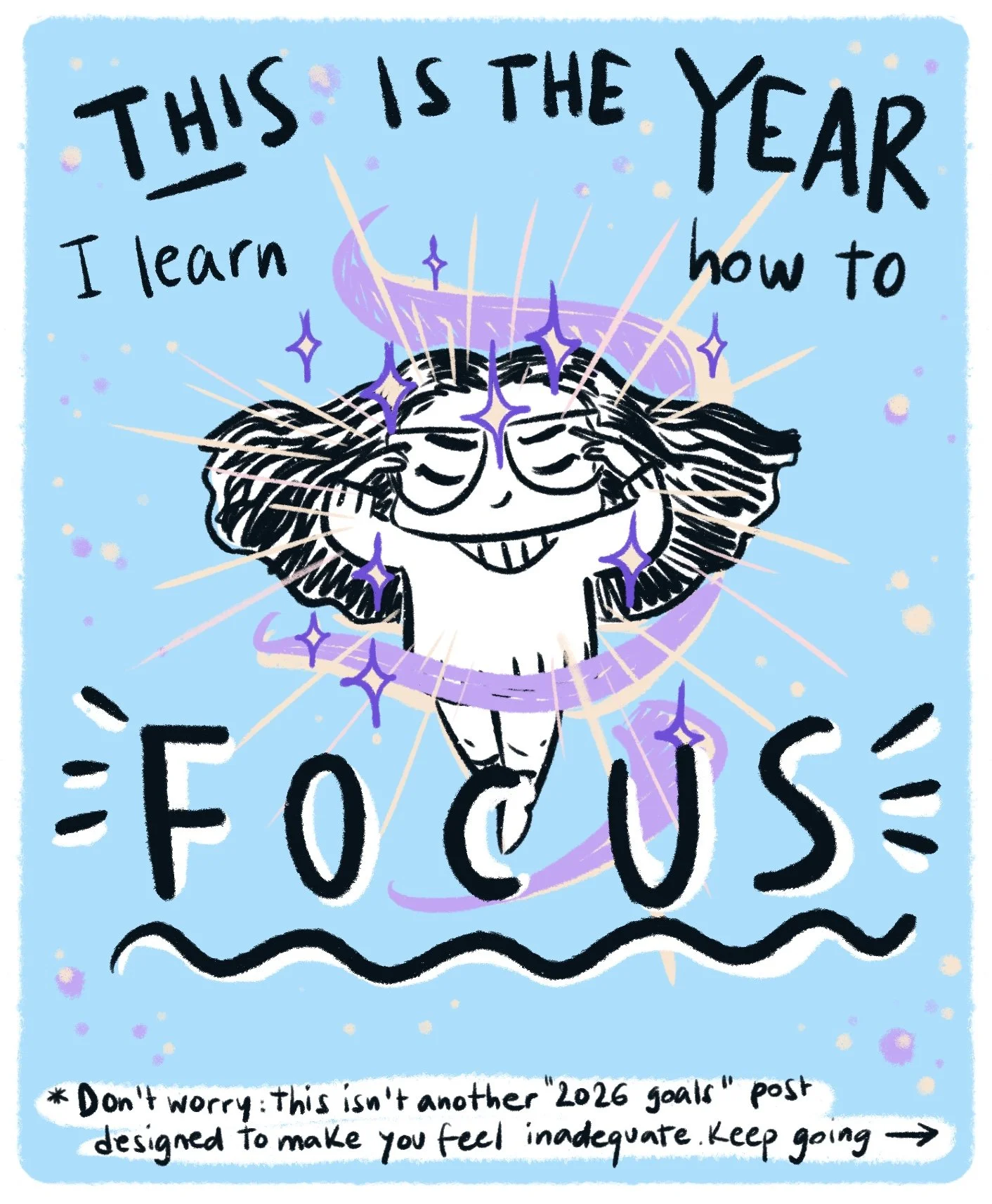
Why I made this (and why it’s not another “2026 goals” post)
This isn’t a “new year, new me” manifesto.
This is a tool for finishing long-term projects even when life happens - kids get sick, work gets chaotic, your energy disappears, your brain latches onto a shiny new hobby, or you simply… forget your goal was a thing.
The Focus Year isn’t designed to make you feel inadequate. It’s designed to help you return.
Over the holidays I did something I basically never do: I stopped.
Like, properly stopped. No side projects, no “just one more thing”, no pretending rest was a reward I hadn’t earned yet.
And during the silent half an hour between sand castles with my toddler and diaper change with my baby, I realised something mildly upsetting: I’d been setting goals like I had three extra lives and a spare nervous system.
So I asked myself what I actually want 2026 to look like. Even though on the surface I had a million goals, they all boiled down to two things:
Better work–life balance (earn what I need while working less, and actually prioritising my health, interests and family time)
Everything else is now… supporting cast.
If a new job, idea, or “ooh shiny” project doesn’t help one of those two goals, it’s either a no, or it gets parked for later.
That’s the whole Focus Year in a nutshell: fewer goals, more follow-through.
The core idea: a Focus Year = 6 goals, one at a time
Instead of trying to do everything at once (my natural habitat), I’m doing six focus cycles across the year.
Each cycle is roughly six weeks:
long enough to build momentum
short enough not to feel endless
with built-in buffer so real life doesn’t wreck the entire plan
No “one goal per month” pressure. No daily tracker that turns into a guilt machine.
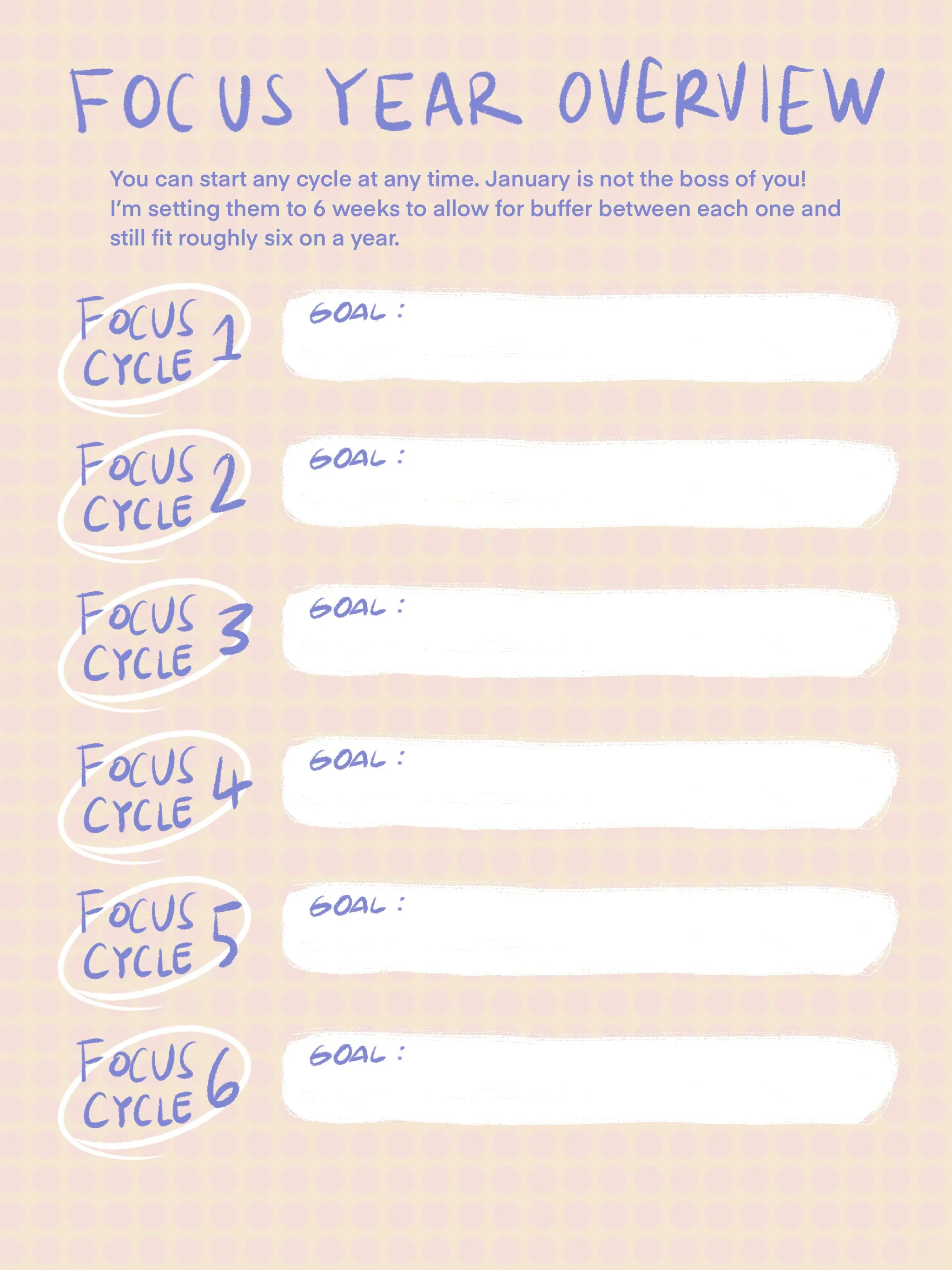
Focus Year overview, aka page 5
What’s inside the Focus Year planner
1) The Decision Funnel (aka “does this serve the main quest?”)
At the start, you define your two anchor goals for the year. Then every time a new job, idea, or side quest appears, you ask:
Does this support Goal A?
Does this support Goal B?
If not → it’s a no.
Or it goes into the “Not now, later” section (more on that below).
This is the only way I’ve found to stop my brain from starting 18 simultaneous lives.
2) “Not Now, Later” (the Future Me waiting room)
This is where shiny new ideas go, so they don’t hijack your current goal.
Instead of trying to ignore the idea (impossible), you park it:
what it is
why it’s exciting
when you’ll revisit it (or… “2027 problems”)
It’s not a graveyard. It’s a waiting room.
3) The Focus Cycle pages
Each cycle guides you through:
defining what “done enough” looks like
breaking the goal into Must / Nice / Optional (so you don’t create a second full-time job)
choosing 1–2 support habits that make the goal easier (tracked weekly, not daily)
mapping the 6 weeks in a low-pressure way
4) The Week 3 Reset (because that’s when it all goes sideways)
Halfway through a goal is when many of us hit:
boredom
resistance
anxiety
or total amnesia about why we cared in the first place
So the planner includes a midpoint reset to help you re-engage without changing your goal.
It asks things like:
Did you forget about this goal?
What’s working? What isn’t?
How can we make it interesting again without switching projects?
This is the page I wish every planner had… let’s see if it’ll help me actually finish the thing.
5) Tokens + an optional board game (yes, really)
Some brains do better with tactile reminders than phone notifications (because phone notifications are extremely easy to snooze), so when I had the idea of physical tokens you can take out, stick on your computer screen, and put away, I actually squealed with excitement.
So I designed:
printable tokens (like “I showed up”, “I worked on the thing”, “I forgot: restarting”, “rest day”)
an optional Focus Cycle board you can use to gamefy your progress
Not for streaks. Not for “earning” anything.
Just tiny props to help your brain remember what it’s doing.
Okay, enough of me yapping
If you want to try the thing (and please let me know your feedback if you do, cause I’m still tweaking it), you can download it here.
If you want to do this alongside other creatives, I’ve got two options:
Join my mailing list for resources + updates
Come hang out with us in The Scribble Coven on Discord (a supportive community of creatives doing the messy, real version of making art)
Love and Chaos,
memo ✨🖤
FAQs
-
Am I qualified to create materials for neurodivergent people? Absolutely not. I’m a professional illustrator with a degree in Publishing, and I'm an expert in nothing. But, I am neurodivergent, and I made this to help moi. If it helps you, too, fantastic!
-
No. It’s designed to work even if you don’t touch it every day.
-
You will. That’s normal. The system is built around restarting.
-
Yes: it’s made to work digitally (PDF import in Procreate, Goodnotes, or whichever app you use for note-taking) or printed.
-
No. Do fewer. Do one. Do whatever your year allows.